
Trade War Dashboard — global trade policy, made easier to understand
NeuNov Technologies built Trade War Dashboard: a public platform that brings international trade news and interactive trade-policy analysis into one place — helping anyone see what’s happening with tariffs and trade, where the information came from, and why it may matter.
Data and context, in one place
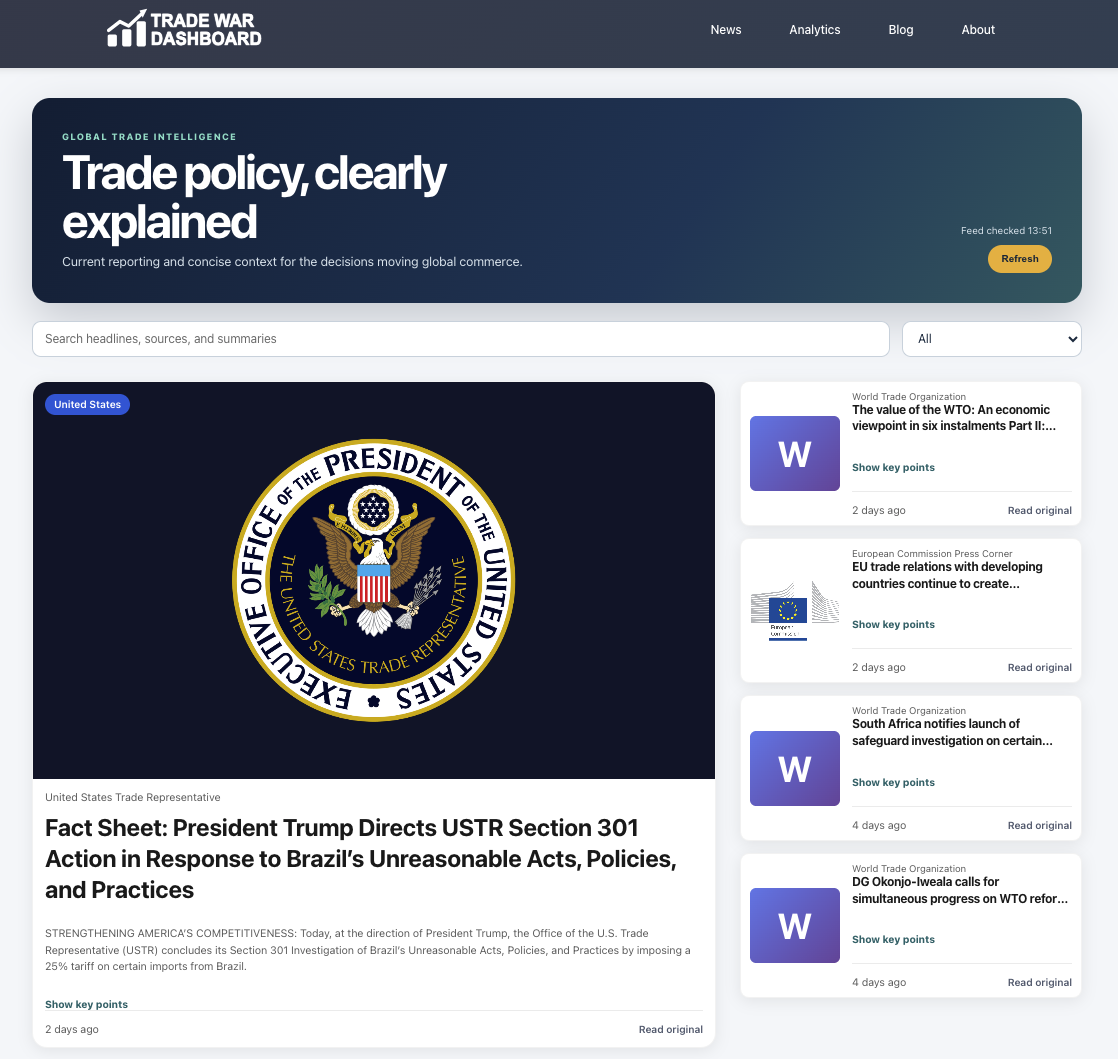
Source-linked news
A clean news experience with featured, trending and latest layouts, clear publisher labels, publisher-derived publication dates, concise summaries and key points — and a direct “Read original” link to every story at its source.
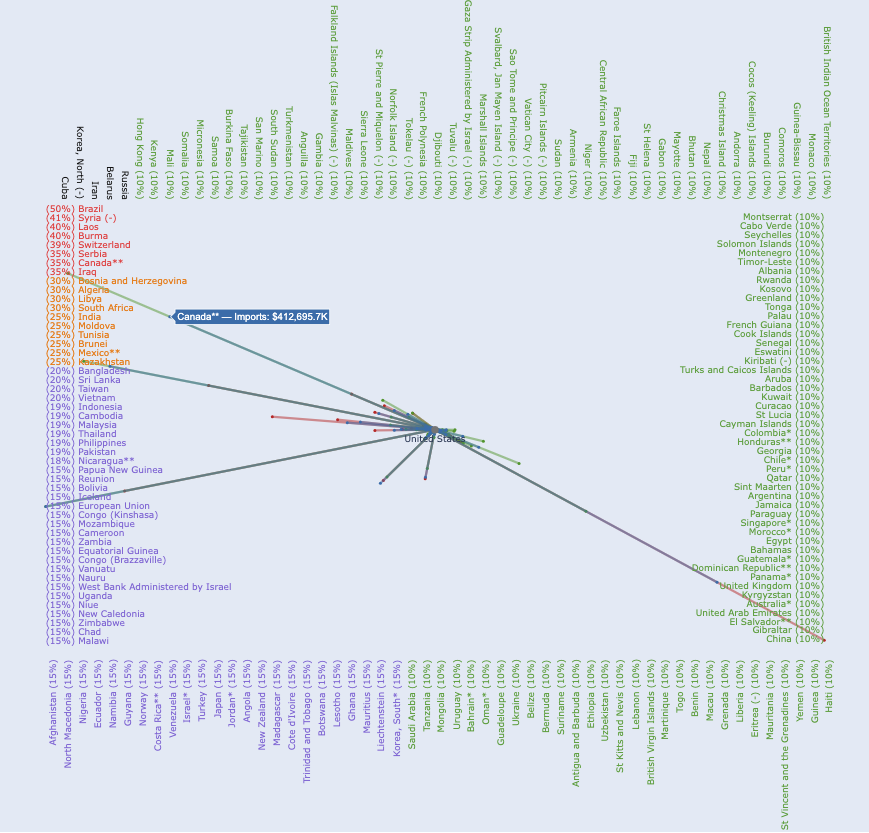
Interactive trade & tariff analysis
An embedded dashboard for comparing the United States’ trade relationships — 2024 trade deficit, exports, imports and tariff measures — across roughly 200 countries and economies, with a country-to-US network view, sorting and hover detail.
Publisher-verified sourcing
Every candidate story is checked against its original publisher page before it’s accepted, with the true publication time kept separate from processing time — so what you read is traceable, not just aggregated.
Context & education
Longer-form blog content and a plain-language About section translate complex tariff and trade-balance topics into something business leaders, researchers, students and citizens can actually follow.
How it was built
A publisher-grounded news pipeline
A configurable Python pipeline discovers stories from a registry of trusted RSS/Atom feeds — including the WTO, UN economic-development coverage, the European Commission, the Office of the US Trade Representative, BBC Business, The Guardian, NPR and the Bank of Canada — with optional supplemental discovery through GDELT. Every candidate, from any source, must still pass the same publisher-page verification.
Publication-time integrity
The original publication time is verified on the publisher page and stored separately from the pipeline’s ingestion time, so displayed dates reflect when a story was actually published — not when it was processed. A common failing of news aggregators, fixed by design.
Quality gates over raw volume
Candidates are accepted only after passing freshness, canonical-URL de-duplication, extracted-content length, summary and key-point checks. Enrichment is deterministic and publisher-grounded (extractive, not generative) — a defensible record, not a guess.
Interactive analytics over a real dataset
The analysis app is built in Python with Dash, Plotly and pandas over a curated tariff dataset of roughly 200 economies plus historical and annual UN Comtrade-derived trade data — over 324,000 rows across the principal files — surfaced as an interactive, US-focused trade-policy visualization.
Serverless AWS delivery
A React single-page app served from S3 + CloudFront over Route 53 and HTTPS, with a read-only public news API on API Gateway + Lambda and storage in DynamoDB. Public read access is deliberately separated from authenticated ingestion, and repeatable infrastructure is captured in CloudFormation templates.
Tested, secured and transparent
Automated Python and frontend tests cover the pipeline, the news API and the React experience. Secrets stay in environment variables, CORS is limited to the production domains, the embedded analytics frame is sandboxed — and the platform’s limitations (optional discovery sources, periodic rather than real-time refresh) are documented rather than hidden.
A closer look
Built for traceability and trust
Trade War Dashboard reflects how NeuNov approaches information products: prefer verifiable data over assumptions, preserve where every fact came from, and be candid about limitations. News is periodically refreshed through a one-command operator workflow (automatic scheduling is on the roadmap), summaries are publisher-grounded rather than generative, and every story links back to its original source.
Built by NeuNov Technologies with AI-assisted engineering. Content is provided for educational and informational use.
Want NeuNov to build your next data platform?
Real data, traceable sources, and production-grade delivery — for trade policy, or whatever your numbers are about.