
When the alarm fires, the right person answers.
Ackloop turns any alarm into a phone call to the right person, collects their acknowledgement, and escalates automatically until someone responds. No code. No YAML. Set up in minutes.
On the call we can place a real alert call to your phone · A product by NeuNov Technologies
SNMP trap · 03:02
PDU-04 input feed lost — Rack B12
Priya · Shift lead
Called 03:02 · no answer after 30s
Marc · Facilities
Called 03:03 · no answer after 30s
Dana · On-call eng
Answered 03:04 · pressed 1
Illustrative escalation. Rosters, timeouts, redial counts and keypad actions are configured on the workflow canvas.
Critical alerts fail silently in an inbox
Emails get ignored. Texts have no acknowledgement loop. When infrastructure fails, someone needs to hear a phone ring.
Reaches a human, guaranteed
Multi-hop escalation keeps calling down your roster — with configurable timeouts and per-step redials — until someone acknowledges. No silent failures.
Works with your monitoring
Native SNMP traps, syslog and HMAC-signed webhooks, normalized into one pipeline. The protocols DCIM and BMS tooling actually speak — no middleware translator.
Storm-proof by design
De-duplicates by alarm fingerprint and rolls a flood into a single summary call, so a cascading incident doesn’t become fifty calls to one exhausted engineer.
From alarm to acknowledgement
- 01
An alarm fires
Power, cooling, security or network — ingested from an SNMP trap, a syslog message or a signed webhook, then normalized into a single event pipeline.
- 02
Ackloop calls the right person
It dials your on-call, speaks the alert in natural text-to-speech with the alarm details filled in, and waits for a keypad acknowledgement.
- 03
No answer? It escalates
Down your roster automatically, with retries and timeouts guaranteed by a durable workflow engine rather than left to a cron job and hope.
- 04
A keypress becomes an action
Press 1 to acknowledge, 2 to dispatch — firing real downstream actions like tickets or hand-offs, not just writing a line to a log.
The whole escalation, on one canvas
This is the actual builder. An alarm arrives, the on-call is called, thirty seconds of silence sends it to the manager, and a keypress ends it — assembled by dragging nodes and filling in form fields.
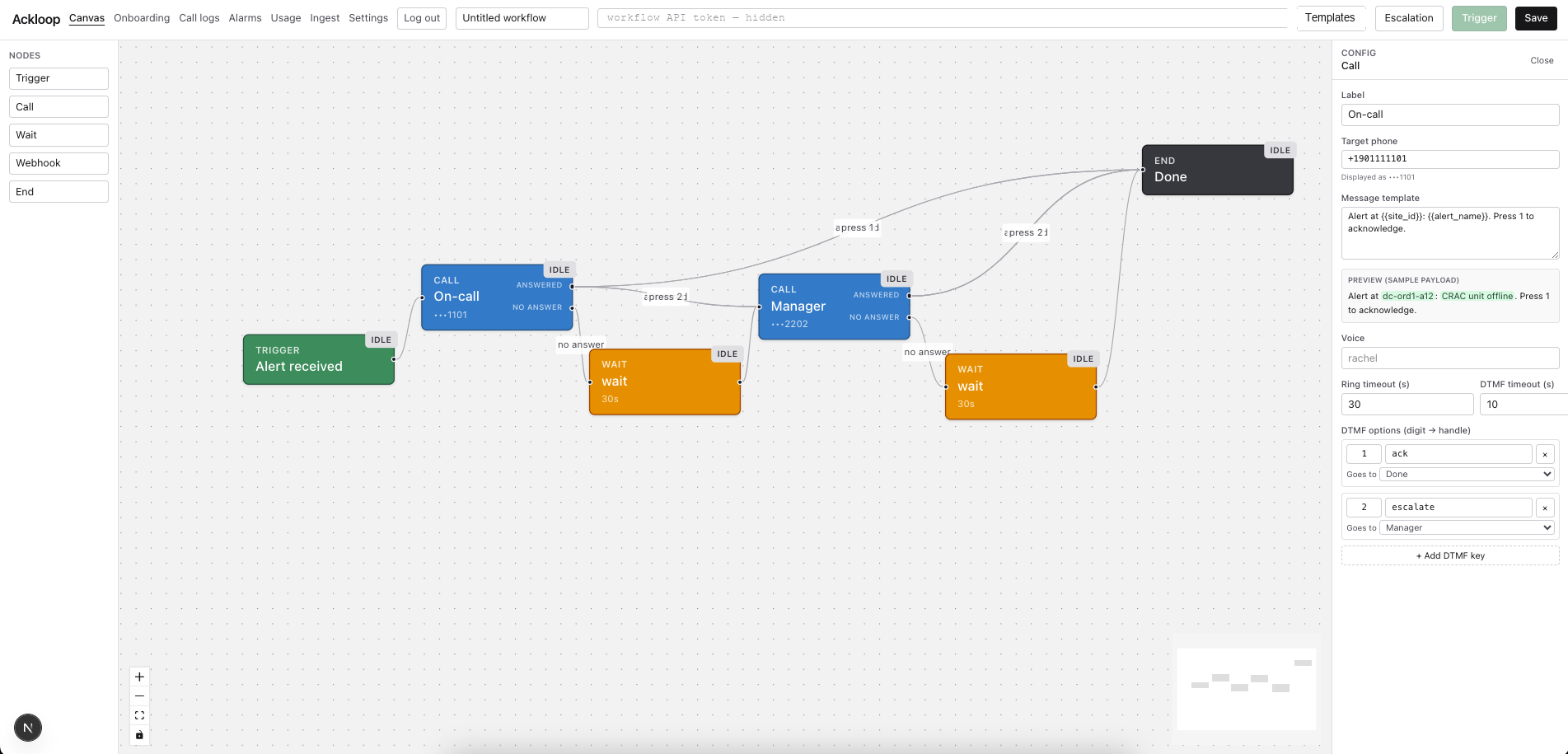
Nodes, not code
Trigger, Call, Wait, Webhook and End blocks dragged onto the canvas — the whole escalation is assembled without writing anything.
Routing you can see
Every outcome is a labelled wire: “press 1”, “press 2”, “no answer”. The path an alarm takes is readable at a glance instead of buried in config.
Templated alert text
The spoken message pulls live values — {{site_id}}, {{alert_name}} — with a sample-payload preview showing exactly what the on-call will hear.
Timeouts you control
Ring timeout, DTMF timeout and wait durations are plain form fields on each node, tunable per step without redeploying anything.
Keypad to destination
Each DTMF digit maps to a named handle and a target node — 1 to acknowledge and finish, 2 to escalate to the manager.
Test before you trust it
Trigger the workflow straight from the canvas and watch each node change state, before any monitoring is pointed at it.
Built for the people who keep the lights on
Operations teams whose alarms are physical, whose monitoring is older than their alerting tool, and whose buyer configures with forms rather than YAML.
Data center facilities
Regional and edge colocation operators running DCIM/BMS monitoring, where power, cooling and security alarms have to reach a human fast — and the team is chronically short-staffed.
NOC managers
Regional telecoms, utilities and internet providers whose network alarms currently land in a mailbox nobody watches between midnight and six.
MSPs
Managed service providers running NOC-as-a-service, who need per-client rosters, per-tenant caller ID and an auditable record of who was called when.
Hospital IT & logistics
Operations teams outside the software world where an unacknowledged environmental or systems alarm has consequences well beyond a missed SLA.
Everything an on-call needs — nothing it doesn’t
Ackloop is a workflow builder for phone-call alerting. It is not a chatbot, a dashboard you have to watch, a phone system, or a generic autodialer.
Visual workflow canvas
Drag-and-drop call flows on a canvas. No code, no YAML, no engineer required to change who gets called.
Routing you can see
Every keypress is a labelled wire on the canvas, so the escalation path is readable at a glance instead of buried in a config file.
Multi-hop escalation
A configurable roster with per-step timeouts and redial counts, escalating through several hops until someone picks up.
DTMF response capture
Keypad acknowledgement branches the workflow — different keys take different paths, deterministically.
Structured actions on response
A keypress fires a webhook, opens a ticket or triggers a dispatch. The call does something, rather than just informing someone.
Multi-protocol ingestion
SNMP traps, syslog and HMAC-signed webhooks, all normalized into the same event pipeline.
Alarm lifecycle tracking
OPEN → ACKED → CLEARED, with fingerprint de-duplication so a repeating alarm stays one alarm.
Auto-cancel on resolve
When the source clears the alarm, any in-flight escalation is cancelled — nobody gets woken for a problem that already fixed itself.
Alarm-storm suppression
Floods roll up into a single summary call instead of dialing the same person once per alarm.
Text-to-speech alerts
Spoken messages with templated variables, rendered once and cached so a repeat alarm costs nothing to speak again.
Live call dashboard
Real-time status of every call and escalation in flight, plus the history of who was reached and when.
Pre-built vertical templates
Starting points for data center, NOC, hospital and logistics rosters, so the first workflow is an edit rather than a blank canvas.
Per-tenant configuration
Caller ID, voice and escalation contacts configured per tenant — built for MSPs running several clients.
Self-serve test call
Send yourself a real call during onboarding, before you connect any monitoring to it.
Usage metering & export
Per-minute and per-call accounting you can export, so operational spend is visible rather than a surprise.
On the roadmap: AI-guided voice input (speech-to-text) for structured data collection, SMS fallback, and domain-specific voice agents built on the same engine.
Notification tools tell you something is wrong.Ackloop makes sure a human picks up — and acts.
Instead of PagerDuty / OpsGenie
Built for the facilities and NOC buyer, not for SREs reading Slack. Voice-native, so a keypress triggers a real action rather than another notification — and priced for an operations budget.
Instead of AI voice agents
Deterministic and durable. The same alarm always runs the same call-and-escalate sequence, with guaranteed retries and timeouts. Predictability beats an LLM improvising in the middle of an incident.
Instead of Building it yourself on Twilio
The trunk is the easy part. Getting a spoken alert reliably onto a live call took four independent fixes below the API surface — media format, audio hosting, codec wiring and certificate trust. Then the durable escalation state machine takes the quarters. All of it is already built.
Instead of Legacy on-prem IVR
Cloud SaaS with no on-prem hardware and no specialist config — a visual builder anyone on the team can pick up, instead of a system only one contractor understands.
Instead of Spreadsheet phone trees
Automated, auditable, and it never forgets to call the next person or dials a number that went stale eighteen months ago.
Engineered for the 3 AM call
Reliability is guaranteed at the architecture level, not promised in a support agreement.
Durable workflow engine
Escalation state, retries and timeouts are guaranteed by the platform and survive failures mid-incident. This is the reliability core, not a scheduled job that hopes to run.
Carrier-grade voice
FreeSWITCH media handling over an elastic SIP trunk, running on Kubernetes with a dedicated static IP for stable carrier identity.
Provider-agnostic speech
Speech generation sits behind an internal interface with more than one working implementation, so the engine can be changed for cost, quality, language coverage or data residency without touching call logic.
Event-driven backbone
A Kafka-compatible streaming bus connects ingestion, orchestration and billing, so each part can scale and fail independently.
Protocol listeners
Native SNMP-trap and syslog daemons normalize legacy monitoring into the same pipeline as modern webhooks — no translator to maintain.
Cloud-native & scalable
Go services on Kubernetes (AWS EKS) with PostgreSQL and Redis, and the whole environment defined as code in Terraform.
An engine for calls — alerting is the first thing built on it
Ackloop was built as a general call-automation engine with alerting as its first application. That is a deliberate architecture choice, and it is where the product is heading next.
- Step 1
Today: the alerting application
Ackloop’s first application is critical-infrastructure alerting — alarm in, phone call out, acknowledgement captured, escalation guaranteed. That is what you can book a demo of and run this quarter.
- Step 2
Underneath: a call-automation engine
Alerting is one workflow on a general engine. Placing calls, speaking generated text, capturing keypad input, branching deterministically, retrying, timing out and firing downstream actions are all engine primitives — not features welded to alarms.
- Step 3
Next: domain-specific voice agents
The same engine is the substrate for agents that complete a task over the phone rather than just report one — confirming appointments, chasing a missing document, verifying a dispatch, collecting structured field data. Each agent is a new workflow on the canvas, bounded by the same deterministic contract.
- Step 4
Why that matters when you buy today
The alerting deployment you stand up now is the same substrate those agents run on. Extending into a new call workflow later is a workflow you draw, not a second vendor, a second integration and a second procurement cycle.
Domain-specific voice agents are the roadmap direction, not a shipping feature. What you can deploy today is the alerting application and the engine underneath it.
See our agentic workReliability by architecture
The voice path is proven, not theoretical
The full chain — alarm to workflow to outbound PSTN call to spoken alert to keypress to escalation — has been executed end to end against a real carrier trunk, not simulated.
Domain depth, designed in
The approach is a modern rebuild of a system operated at telecom-carrier alarm volume. Alarm floods, de-duplication and guaranteed escalation were designed in from day one, not learned after a bad night.
Alert audio is never public
Rendered speech is stored privately and reachable only from inside the platform’s own cloud network, so the contents of an alert are never exposed on the open internet.
No voice-vendor lock-in
More than one speech implementation genuinely exists behind the same interface, so a vendor’s pricing change or a data-residency requirement doesn’t become a rewrite.
Ackloop delivers operational alerting to a pre-registered on-call roster with a consent audit trail — not cold outreach. It is built for caller-ID deliverability, with STIR/SHAKEN attestation support planned as we provision carrier numbers. SOC 2 readiness is on our roadmap; we hold no certification today. Pilot evidence reflects controlled end-to-end runs on a live carrier trunk and is not a claim about uptime, latency or concurrency at scale.
Hear it ring for yourself
Book a 30-minute live demo. We’ll walk the workflow canvas, fire a real alarm, and — if you want — place a live call to your phone so you can acknowledge it yourself.
30 minutes · no procurement · bring your monitoring setup and we’ll map it live
Questions operators ask
How is this different from PagerDuty?
Isn’t this just an AI voice bot?
Our monitoring doesn’t do webhooks. Can we still use it?
What happens during an alarm storm?
What does the live demo cover?
How is it priced?
What about compliance and call deliverability?
Is Ackloop only for alerting?
How quickly can we be running?
More from NeuNov
Public products we designed, engineered and deployed end to end.