Products people actually finish using
Fast, accessible, search-ready web and mobile applications — customer portals, internal tools, native apps, public products — built to be handed over, with AI inside only where it earns its place.
- Web apps & portals
- iOS & Android
- Performance & SEO
- Accessibility built in
The state of most builds
“An agency built it and now nobody can change it.”
No documentation, no tests, no deployment process anyone still understands. Every small change becomes a quote and a two-week wait.
“Our site is slow and we’re losing search traffic for it.”
Page speed and Core Web Vitals are ranking inputs, and a heavy build quietly bleeds both traffic and conversions. Fixing it later costs more than building it right.
“Our internal tool is twelve spreadsheets in a trench coat.”
It works, right up until two people edit at once, or someone new needs to be trained, or you need to know who changed what and when.
“It demoed fine and fell apart on real devices.”
Older phones, screen readers, patchy connections, small screens. Real conditions are where accessibility and performance stop being checkboxes and start being revenue.
What we build
Design and engineering under one roof, shipped in short cycles you can see — with the repository, the pipeline and the documentation handed to you at the end.
Web applications & portals
Customer portals, booking and scheduling systems, member areas and dashboards — with authentication, roles, payments and integrations into the systems you already run.
Mobile applications
Cross-platform apps from a single codebase where that is the right trade-off, and fully native iOS or Android where the experience or the hardware demands it — including offline-capable field apps.
Marketing sites built for search
Fast, statically rendered sites with clean semantics, structured data, sensible metadata and analytics wired up — sites that get found, not just sites that look good in a mockup.
Internal tools & admin panels
The unglamorous software that replaces a shared spreadsheet: proper permissions, validation, an audit trail, and an interface your team can be trained on in an afternoon.
AI features in-product
Semantic search, summarisation, drafting and in-app assistants — added where they measurably shorten a task, and left out where they would just be a badge on the marketing page.
Performance, accessibility & SEO
Core Web Vitals budgets, WCAG-conscious markup, keyboard and screen-reader support, semantic HTML and structured data — engineered in from the first commit, not audited in at the end.
What you actually get
A deployed product and everything a future developer needs to keep working on it — including one who has never met us.
Scope this with us- A deployed application on infrastructure you control
- The source repository with CI/CD and a staging environment
- A component library and design system for consistent future work
- Measured performance and accessibility baselines at launch
- Analytics, structured data and search essentials configured
- Documentation, a team walkthrough and full code and IP handover
From first call to handover
- 01
Scope the smallest useful version
We cut the wish list down to what actually has to exist for the product to be worth using. Everything else becomes a later phase — that is how a build stays fixed-scope and lands on time.
- 02
Design the real screens
Interface design against real content and real edge cases, not lorem ipsum in a happy path. You approve how it looks and behaves before we build it.
- 03
Build in short cycles
Working software on a staging URL you can click through as it develops, with a demo each cycle. No status reports standing in for progress you can’t see.
- 04
Launch and hand over
Production deployment with monitoring, analytics, performance and accessibility baselines recorded, documentation written, and a walkthrough for whoever maintains it next.
Web & Mobile Development in the real world
Some of the products this discipline covers — most engagements start as one of these:
Customer portals
Clients log in to see their orders, documents, invoices and status without emailing your team to ask.
Booking & scheduling
Availability, reminders, payments and rescheduling handled by the product instead of by phone tag.
Field & operations apps
Mobile apps for crews on site — capture photos, forms and signatures offline, sync when there is signal.
Marketplaces & directories
Multi-sided platforms with listings, search, messaging and payments, built to be indexed by search engines.
Marketing & content sites
Fast, structured, search-optimised sites your marketing team can update without filing a developer ticket.
Public data products
Interactive tools built on a live dataset — the kind of product that earns links, coverage and inbound interest.
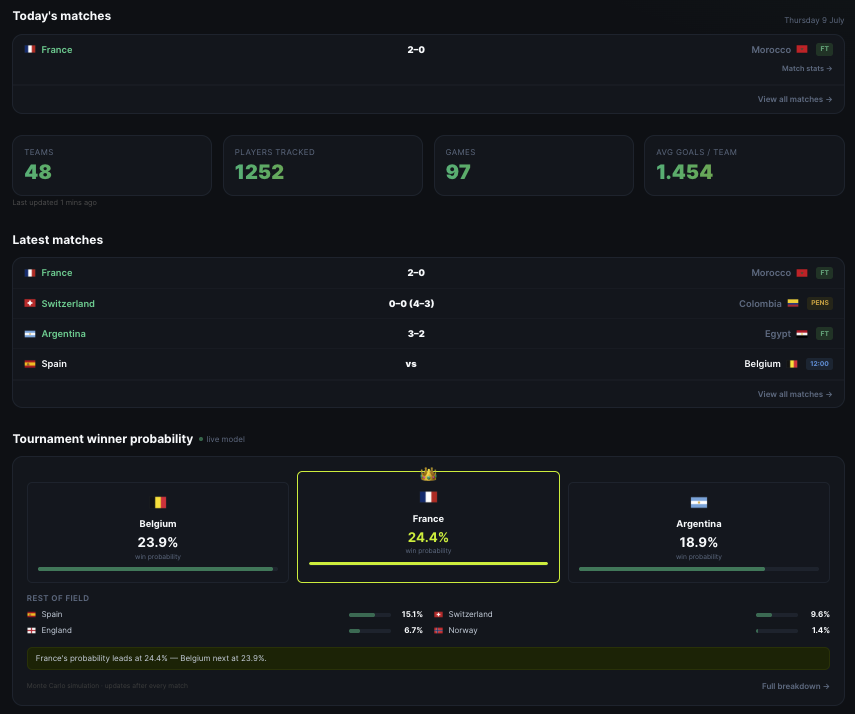
Two public products, live and self-running
AnalyseThisWC26 is a live analytics platform that refreshes itself after every match with nobody touching it — a Next.js front end over a serverless AWS backend, deployed with infrastructure as code. It is public, it is in production, and you can click through it right now. We build client products the same way.
Read the case studyTools & platforms we build Web & Mobile Development on
- Next.js
- React
- TypeScript
- Tailwind CSS
- React Native
- Swift
- Kotlin
- Node.js
- PostgreSQL
- AWS Amplify
- S3 + CloudFront
- GitHub Actions
Web & Mobile Development — questions we get asked
Do you do design as well as development?
Native app or cross-platform?
Can you take over an existing codebase?
Will the site actually rank?
What does the timeline look like?
What happens if we want changes after launch?
Most engagements touch more than one
A good automation usually needs clean data behind it and a decent interface in front of it. Here’s the rest of what we do.
Got a product that needs building — or rescuing?
A free 30-minute call, and you’ll leave with a straight answer on scope, approach and what it would take to ship it.
Free 30-min call · no commitment · you own everything we build