
AnalyseThisWC26 — real-time FIFA World Cup 2026 analytics & prediction
NeuNov Technologies built and deployed AnalyseThisWC26: a live platform that turns real FIFA World Cup 2026 data into match analysis, player scouting, a validated multi-model match predictor, and a from-scratch Monte Carlo simulation estimating every team’s probability of winning the tournament outright.
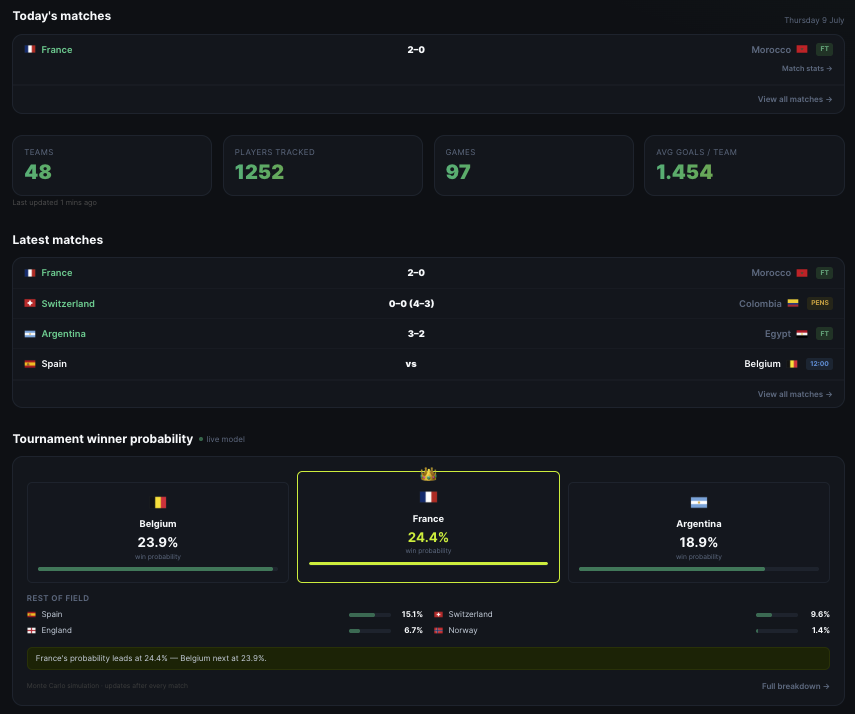
Seven tools, one real dataset
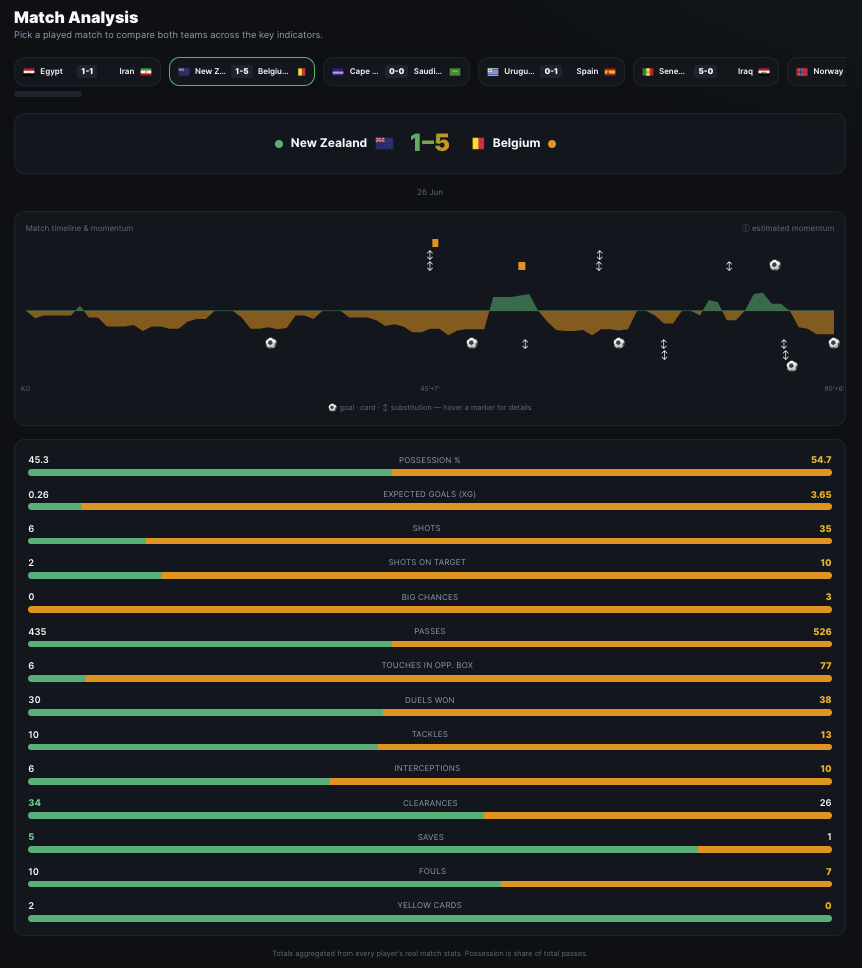
Match Analysis
Every played match with head-to-head team comparison, a timeline of goals, cards and substitutions, and an estimated momentum wave derived from real shot, corner and offside event data.
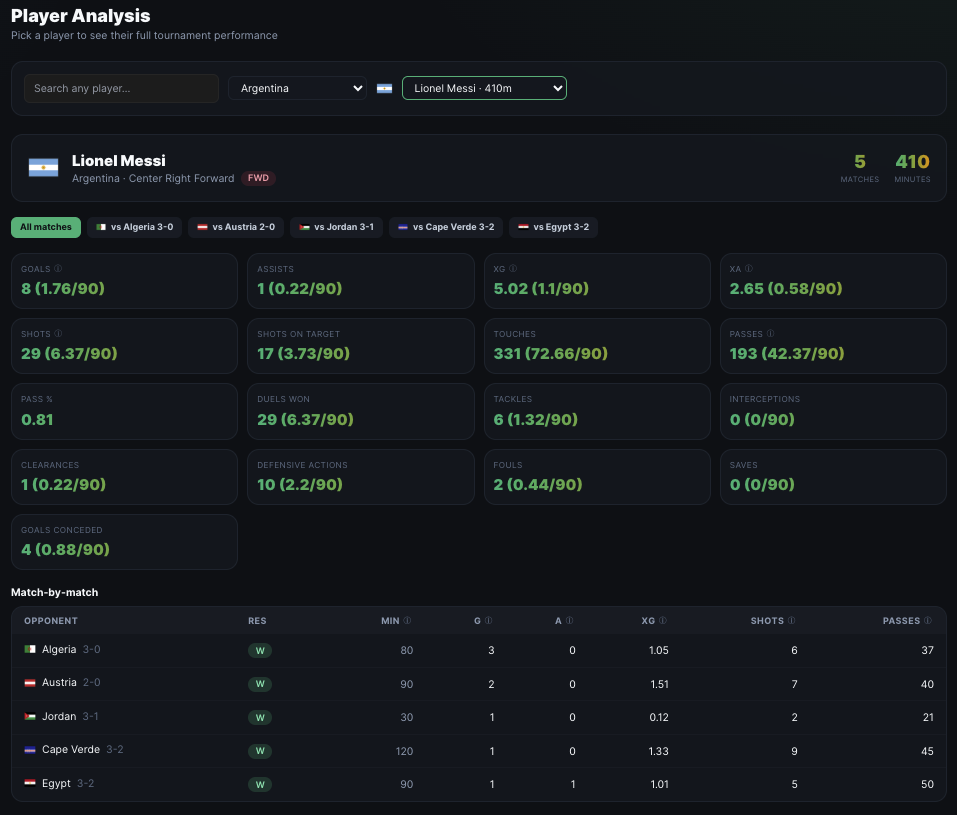
Player Analysis
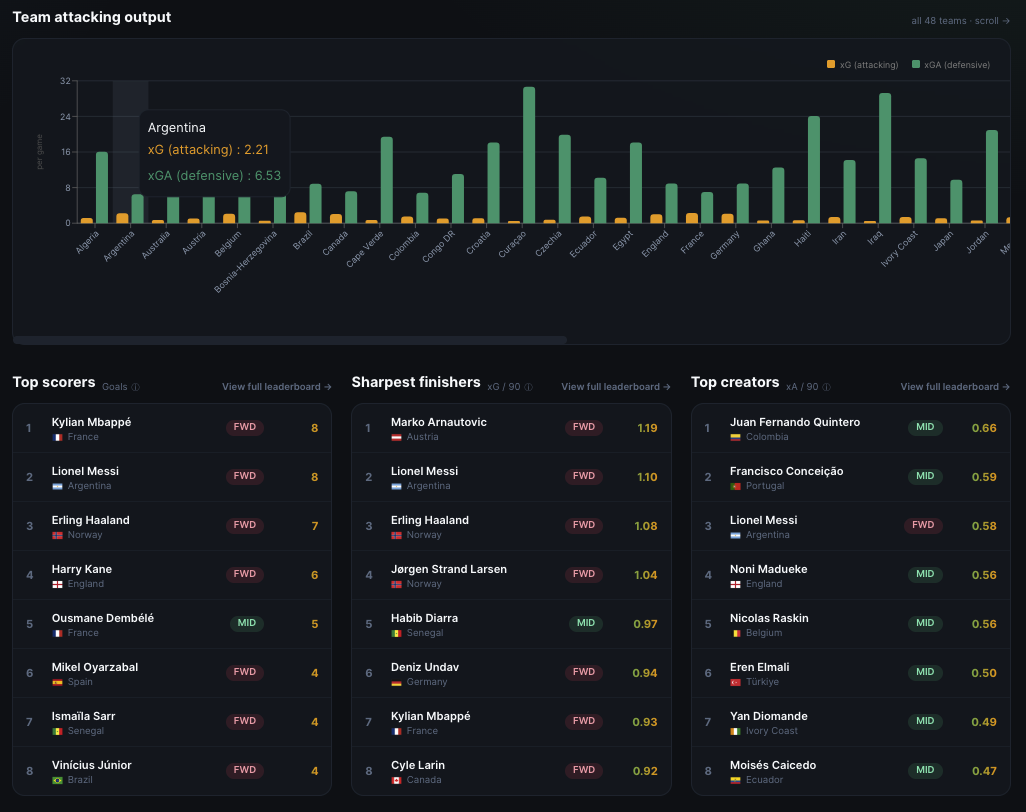
Per-90-normalized stats for every player across the whole tournament — including squad members who haven’t played yet — with empirical-Bayes shrinkage so limited-minutes players get a stable, defensible rating.
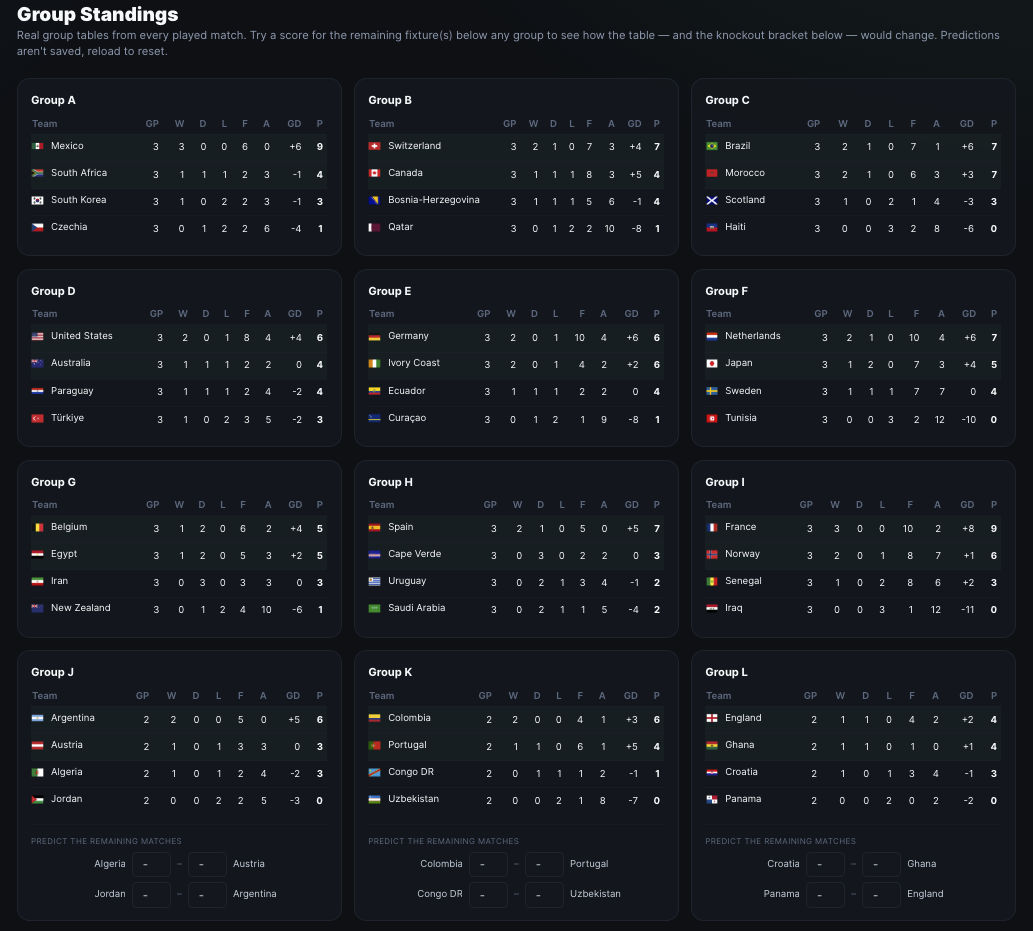
Group Standings
Real, live tables for all 12 groups with an interactive “what-if” predictor that recomputes each group’s remaining fixtures instantly, client-side.
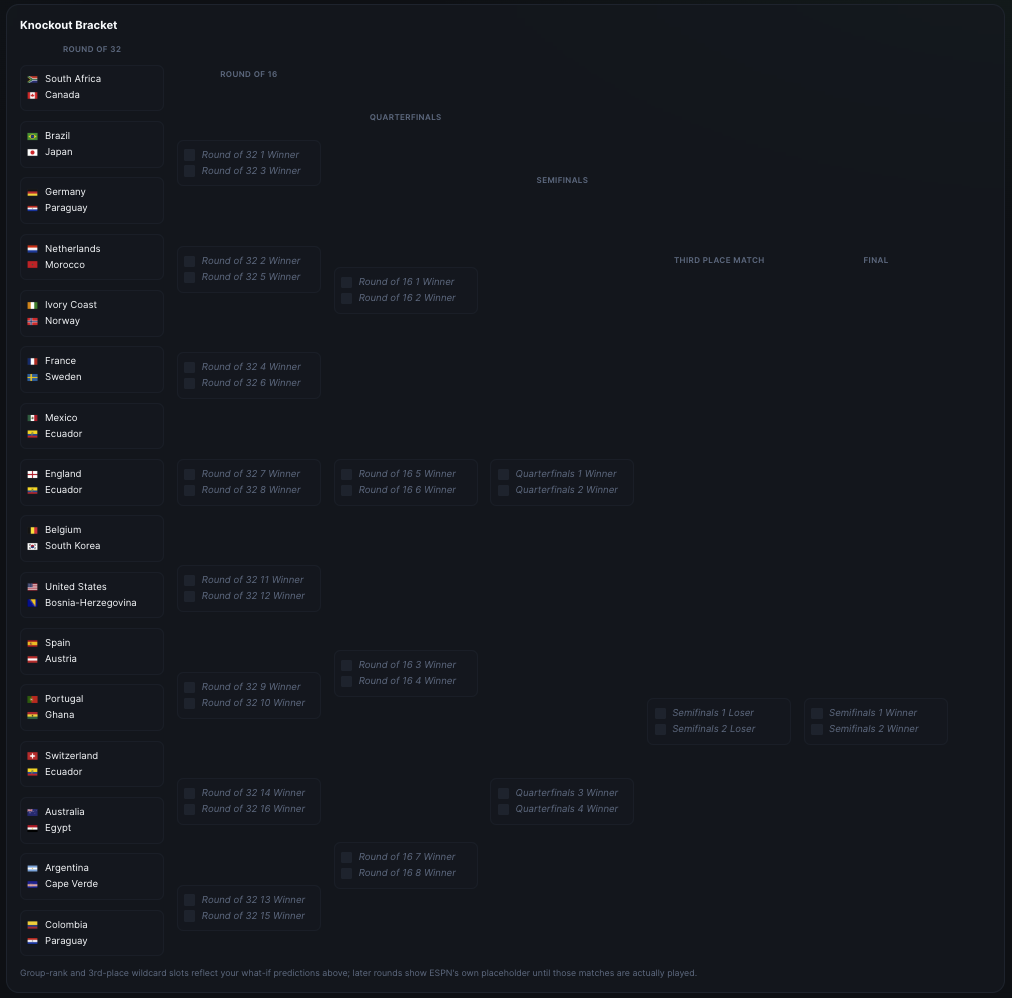
Knockout Bracket
Round of 32 through the Final, resolved from real ESPN bracket data. Each unplayed tie shows a predicted winner and a confidence bar, finished matches click through to full analysis, and the whole bracket exports as a single branded, shareable image.
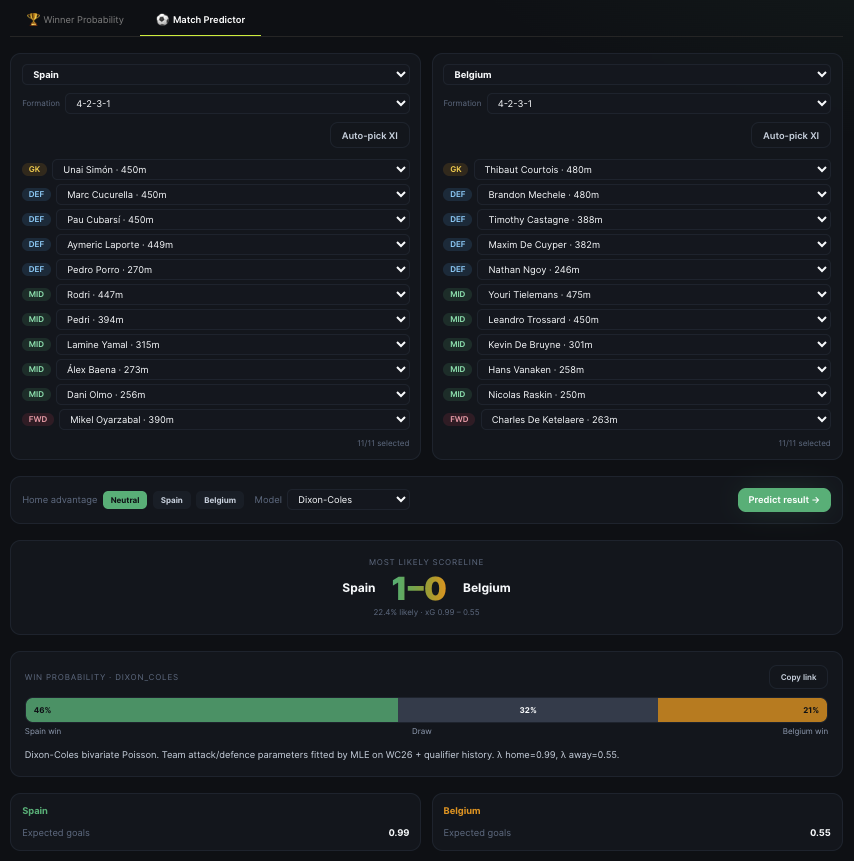
Multi-Model Match Predictor
Pick two teams, build an XI for each, and compare three statistical models side by side — Dixon-Coles, player-Poisson and Elo — for win/draw/loss, expected scoreline and a radar comparison, explained in plain language. Defaults to the best-performing model.
Model Track Record
A live out-of-sample leaderboard: each model is scored on real matches it was never trained on (accuracy + log-loss), so users can see which model is actually calibrated instead of trusting a black box.
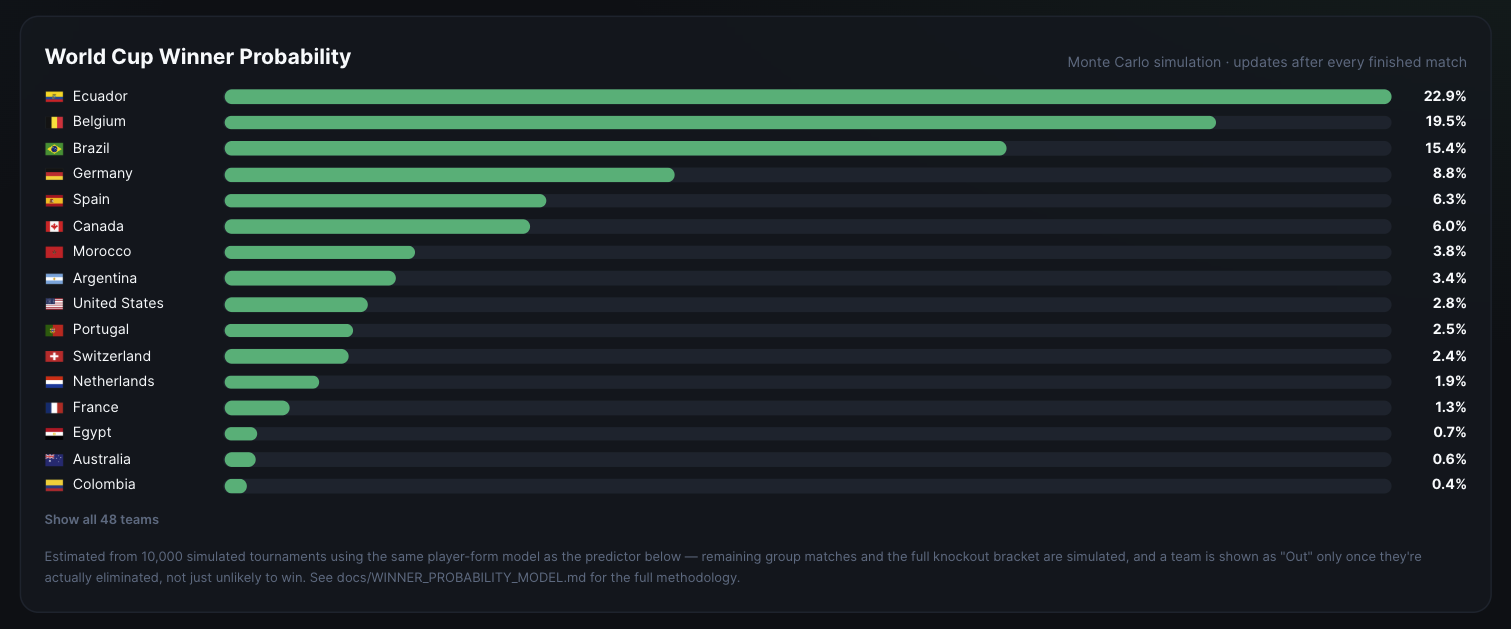
Winner Probability
A Monte Carlo simulation of 10,000 full tournaments estimating each team’s title chances, recomputed after every finished match, with teams correctly zeroed out only once actually eliminated.
How it was built
A validated, multi-model prediction engine
Three independent statistical models run side by side — a maximum-likelihood Dixon-Coles model, the original per-90 player-Poisson model, and an Elo rating system. Each is backtested on real matches it never trained on (log-loss, Brier, accuracy vs reputation-free baselines); the best-calibrated model, Dixon-Coles at ~59% held-out accuracy, is made the default. A gradient-boosted XGBoost model that failed to beat it was deliberately dropped — validation over assertion.
A from-scratch Monte Carlo tournament simulator
Rather than predicting one match at a time, the platform simulates the entire rest of the tournament — every remaining group match, then the full knockout bracket — 10,000 times. Each team’s “chance of winning it all” is how often they win the Final across those simulated futures, with eliminated teams set to exactly 0% from real results rather than inferred from the simulation.
Reverse-engineered a major sports API’s bracket structure
FIFA’s 48-team knockout format has a notoriously complex rule for which group’s 3rd-place finisher fills which bracket slot. Instead of hand-encoding it, the pipeline empirically discovered and verified how ESPN’s API encodes each match’s bracket position — confirmed correct across every round transition through the Final.
Transparent, defensible methodology — not a black box
Every prediction traces back to real per-90 player performance and parameters fitted to real results. Every weight is visible, every simplification (neutral venues, a disclosed penalty-shootout proxy, tiebreak rules) is documented, and an explicit roadmap for improving accuracy is published alongside the models.
Serverless, infrastructure-as-code cloud deployment
A serverless-first AWS architecture — static frontend on S3 + CloudFront, Python prediction and analytics APIs on Lambda (with ECS for heavier compute) — with the entire environment defined as code in Terraform, so it’s reproducible, versioned and horizontally scalable. GitHub Actions runs end-to-end API tests and k6 load tests on every change.
A continuously self-refreshing data pipeline
An automated job re-scrapes finished matches, fixtures, standings and the bracket on a schedule, safely skips matches ESPN hasn’t marked final, and keeps the whole site — including the models and the win-probability simulation — current after every result. Backed by roughly a year of qualifier and friendly history across every confederation.
A closer look
Built and shipped like client work
AnalyseThisWC26 was delivered as a genuine multi-contributor effort through a standard engineering process — feature branches, pull-request review, and CI checks (automated end-to-end tests plus k6 load testing) gating every merge, with a serverless production deployment defined entirely as code in Terraform. It reflects how NeuNov approaches client work generally: real data over assumptions, methodology that’s measured rather than asserted, and production-grade delivery rather than a one-off demo.
Built by NeuNov Technologies with AI-assisted engineering.
Want NeuNov to build your next product?
This is how we ship — real data, methodology measured not asserted, and production-grade serverless delivery. Tell us what you’re building.