Agents that do the work, not just describe it
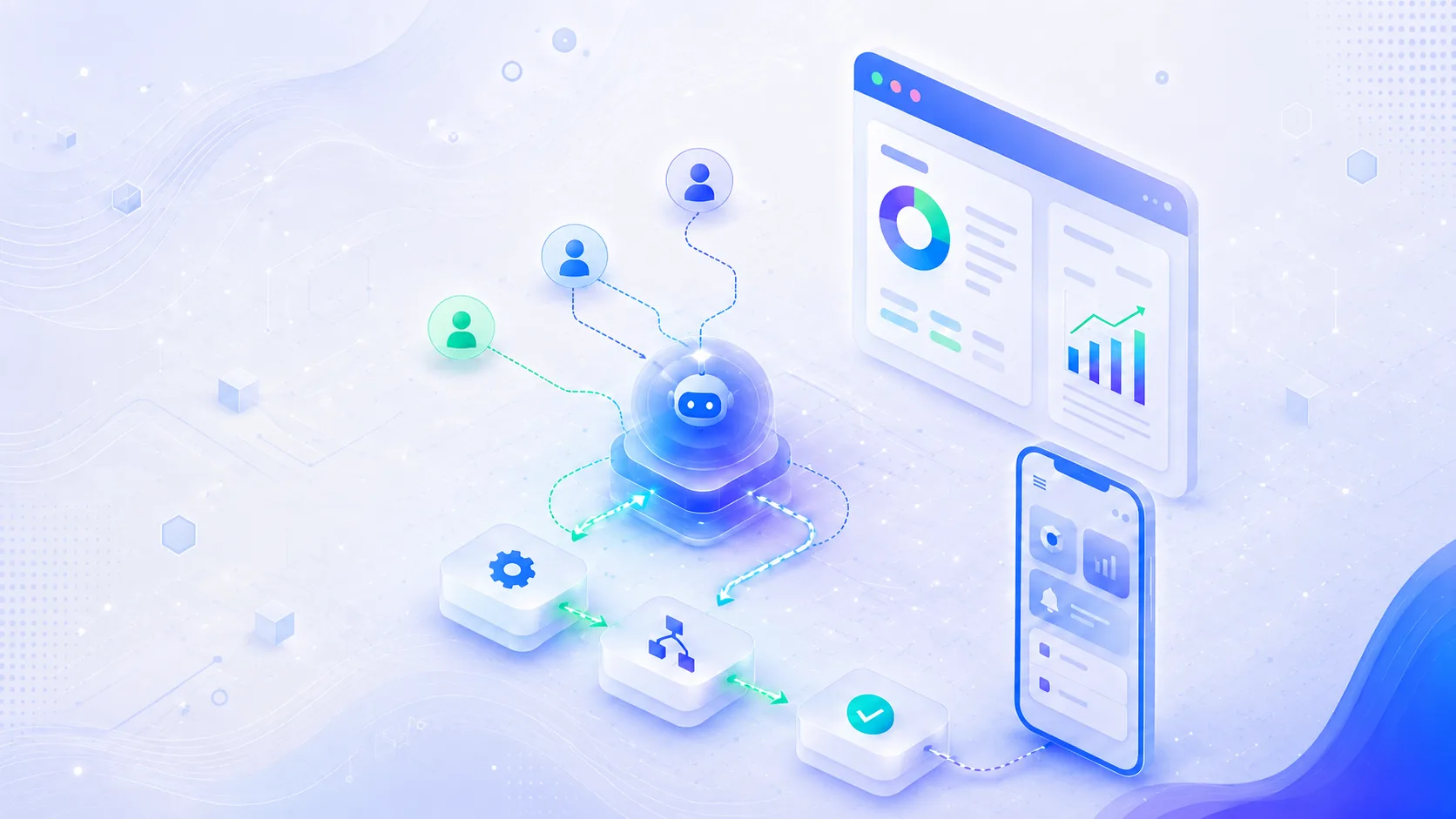
A chatbot answers a question. An agent files the invoice, updates the CRM, chases the missing document, and flags the one case a human actually needs to look at — leaving a log of everything it touched.
- Multi-step workflows
- Tool & system integration
- Human-in-the-loop
- Full audit trail
Where the hours actually go
“We’re the integration between our own systems.”
Someone reads it in one tab and retypes it into another, dozens of times a day. It is invisible on any org chart and it is one of the most expensive things your team does.
“Things fall through the cracks after they’re handed off.”
The follow-up that never got sent, the document nobody chased, the approval that sat for nine days. Not a people problem — nothing is watching the gaps.
“Everything waits on one person to press go.”
Approval bottlenecks are usually 95% routine and 5% judgement. Agents can clear the routine 95% and put the 5% in front of the right person with the context attached.
“We tried an AI agent and it did something alarming.”
Agents without explicit permissions, dry runs, escalation rules and a kill switch are a liability. Those aren’t optional extras here — they’re how we build them.
What we build
Agents scoped to one real workflow, wired into the systems you already use, with clear boundaries on what they may and may not do on their own.
Multi-step workflow agents
Agents that carry a process end to end — read the input, decide, act in the right systems, verify the result, and either close the loop or escalate with a reason.
Tool & system integration
Connected to your CRM, ERP, accounting, ticketing, email, storage and spreadsheets through their APIs — meeting your stack where it is rather than moving you onto a new platform.
Document-driven processes
Intake, extract, validate against your rules, then route — invoices, applications, purchase orders, claims and forms handled from arrival to filed without a manual re-key.
Human-in-the-loop approvals
You decide what runs unattended and what needs a person. Low-confidence and high-value cases are queued for review with the full context and a one-click approve or reject.
Exception handling & escalation
The interesting part of any workflow is what happens when something is wrong. Agents get explicit rules for retries, edge cases, ambiguity and who gets told when they stop.
Audit trails & observability
Every action logged with its input, reasoning, output and timestamp — plus dashboards, alerts and a kill switch, so you can prove what happened and stop it instantly if needed.
What you actually get
An agent that runs in your accounts, under permissions you set, doing a workflow you can point at on an org chart. Not a generic assistant looking for a job.
Scope this with us- A deployed agent scoped to one real workflow, end to end
- Integrations running under your own credentials and permissions
- Written rules for what runs unattended and what escalates
- A complete, queryable audit log of every action taken
- Monitoring, failure alerts and an immediate kill switch
- Runbook, team walkthrough and full code and IP handover
From first call to handover
- 01
Map the workflow
We sit with the people doing the work and trace the real process — including the undocumented workarounds. Nothing gets automated until we can describe it step by step, including every exception.
- 02
Draw the boundaries
Explicitly: what the agent may do alone, what needs approval, what it must never touch, and who gets notified when it stops. Agreed in writing before a line of code is written.
- 03
Build and shadow-run
The agent runs alongside your team first, proposing actions instead of taking them. You compare its decisions against your own until the disagreement rate is boring, then we turn it loose.
- 04
Hand over the keys gradually
Autonomy expands step by step as it earns trust — starting with the lowest-risk cases. You keep the audit log, the alerts and the off switch at every stage.
Agentic Solutions in the real world
Agentic automation pays off wherever a process crosses several systems and dies a little at each handoff:
Accounting & bookkeeping
Invoice arrives by email → extracted, coded, matched to a PO, queued for approval, filed — with only the exceptions surfacing.
Sales & CRM
New lead enriched, scored and routed, follow-up drafted and scheduled, and the CRM kept current without anyone updating a record by hand.
Operations
Order and shipment status chased across supplier portals and email, with customers proactively updated before they think to ask.
Customer support
Tickets triaged, tagged and drafted with the relevant history and policy attached, so an agent is editing rather than starting from nothing.
HR & recruiting
Applications screened against role criteria, scheduling coordinated, and candidate records kept in sync across systems.
Legal & compliance
Contract intake, clause flagging against your playbook, renewal-date tracking, and reminders that fire before a deadline instead of after.
An unattended pipeline that verifies its own inputs
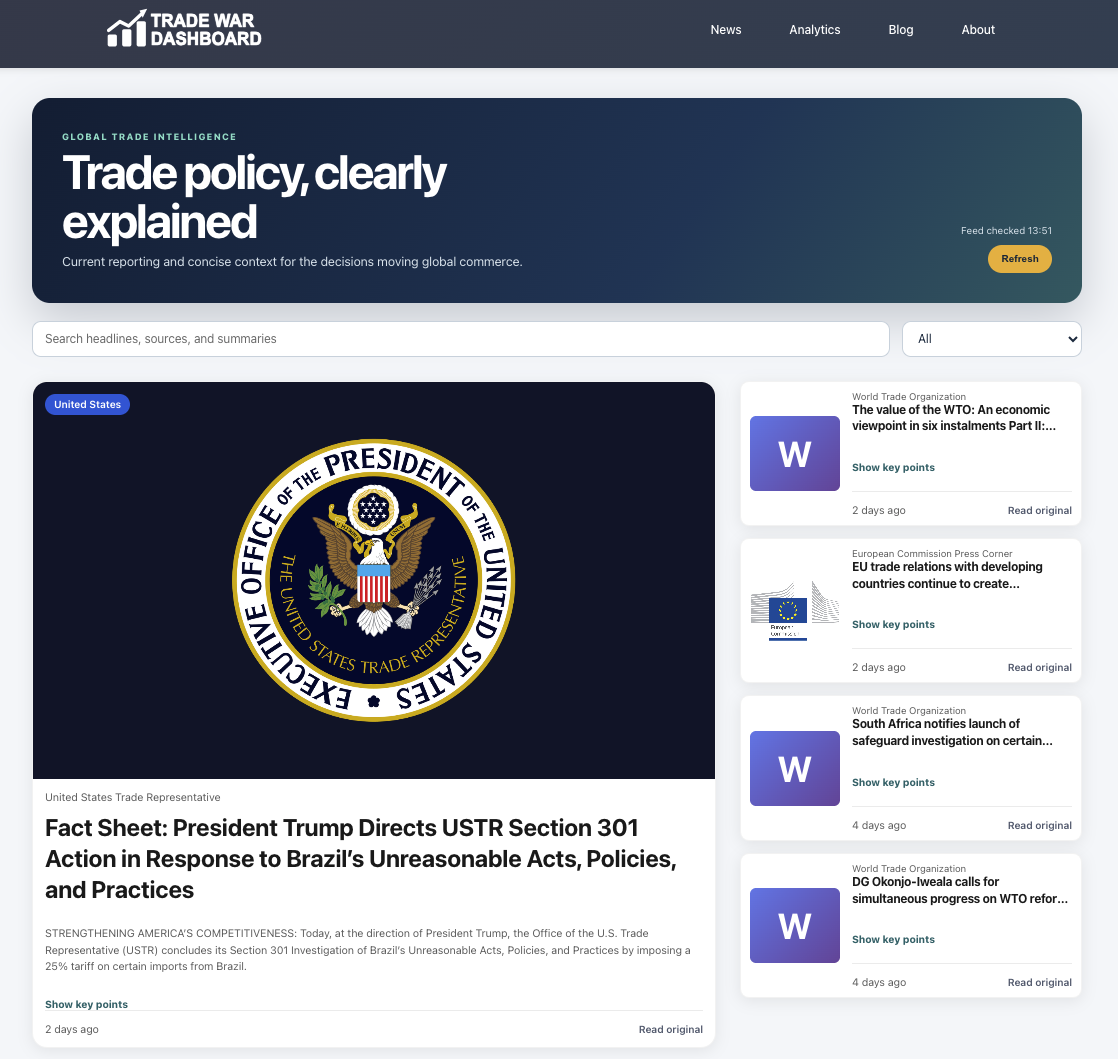
The Trade War Dashboard news pipeline discovers stories from a registry of trusted sources, then checks every single candidate against its original publisher page before accepting it — with freshness, de-duplication and content-quality gates, and publication times taken from the publisher rather than from processing. It runs without anybody watching it. That is what an accountable autonomous system looks like in production.
Read the case studyTools & platforms we build Agentic Solutions on
- Claude
- OpenAI
- CrewAI
- AutoGen
- Model Context Protocol
- Python
- AWS Lambda
- Step Functions
- SQS
- DynamoDB
- REST & GraphQL APIs
- Webhooks
Agentic Solutions — questions we get asked
What’s the difference between an agent and a Zapier automation?
How do we stop an agent from doing something expensive or irreversible?
Does this replace people on our team?
What if our systems don’t have a modern API?
How long before an agent is running on its own?
Can it work across several systems at once?
Most engagements touch more than one
A good automation usually needs clean data behind it and a decent interface in front of it. Here’s the rest of what we do.
What’s the most re-typed thing in your business?
Tell us on a free 30-minute call. We’ll walk you through exactly how we’d hand that workflow to an agent — and where we’d keep a human in the loop.
Free 30-min call · no commitment · you own everything we build