AI that survives contact with production
Most AI projects die somewhere between the impressive demo and the Tuesday in month six when it quietly starts giving wrong answers. We build the unglamorous half — evaluation, guardrails, monitoring, retraining — so the thing you launch keeps working.
- Custom models
- LLM & RAG integration
- Evaluation & guardrails
- MLOps
Sound familiar?
“The pilot was great. Then it stalled.”
A notebook that works on your laptop is not a system. Getting from there to something your team can depend on is a different discipline — and it is the one that usually gets skipped.
“It’s right until it isn’t — and we can’t tell when.”
Without a test set and a scoring harness, quality is a feeling. We put numbers on it, so a change that makes things worse gets caught before your customers find it.
“Our best data is trapped in PDFs and spreadsheets.”
The proprietary knowledge that would make AI genuinely useful to you is sitting in invoices, contracts, email threads and folders nobody has opened in a year.
“Nobody owns it once it ships.”
Models drift, APIs change, costs creep. We hand over a system with monitoring, alerts and a runbook — and documentation written for the person who inherits it.
What we build
Everything below is scoped, priced and delivered as working software you own outright — not a strategy deck or a proof of concept that stops at the demo.
Custom model development
Classification, forecasting, scoring, ranking and anomaly detection trained on your own operational data — where a general-purpose model can’t see what makes your business different.
LLM integration & RAG
Retrieval-augmented systems that answer from your documents, policies and records — with citations back to the source, so answers can be checked instead of trusted blindly.
Assistants & chatbots
Narrowly scoped assistants for support, internal knowledge and onboarding, grounded in approved content, with clean handoff to a human the moment they are out of their depth.
Document intelligence
Extraction and structuring from invoices, contracts, forms, statements and scanned records — turning paperwork into fields your systems can act on automatically.
Evaluation & guardrails
A labelled test set, a regression suite that runs on every change, refusal behaviour for out-of-scope questions, PII handling, and rate and cost controls before anything goes live.
MLOps & lifecycle
Versioned prompts and models, reproducible deployments, drift and quality monitoring, alerting, and a retraining path — so improving it later doesn’t mean rebuilding it.
What you actually get
Every AI Engineering engagement ends with a working system in your environment and everything needed to run it without us. No lock-in, no per-seat licence on your own software.
Scope this with us- A deployed, working system running in your cloud account
- An evaluation harness with a baseline score you can hold us to
- Versioned prompts, model artifacts and configuration
- Monitoring, alerting and cost controls wired up on day one
- A runbook plus a live walkthrough for your team
- Full source code and IP handover — you own all of it
From first call to handover
- 01
Frame the decision
We start from the business decision the model is meant to improve, not the technology. What action changes? Who acts on it? What does being wrong cost? That defines the accuracy bar everything else is measured against.
- 02
Prove it on your data
A focused build against a real sample of your data with a labelled test set, scored honestly — including the option to tell you it isn’t worth doing. Better to learn that in week two than month six.
- 03
Harden it
Guardrails, failure paths, PII handling, cost ceilings, and a regression suite so future changes can’t silently degrade quality. This is the step most projects skip, and the reason most projects don’t last.
- 04
Ship, watch, hand over
Deployment into your environment with monitoring and alerts, a walkthrough for your team, documentation, and full handover. Ongoing iteration is available on retainer if you want it — never required.
AI Engineering in the real world
AI Engineering pays off wherever expert judgement is applied over and over to the same kind of input. A few places it lands well:
Professional services
Contract and proposal review that flags unusual clauses and missing terms before a human reads page one.
Accounting & finance
Invoice and receipt coding to the right account, with confidence scores and low-confidence items routed for review.
Logistics & distribution
Extracting structured data from bills of lading, customs paperwork and supplier PDFs that arrive in fifty different formats.
Healthcare admin
Intake triage and referral routing on structured and free-text notes, keeping clinicians out of the paperwork queue.
Retail & e-commerce
Demand forecasting, product categorisation and review analysis on your own catalogue and sales history.
Field services
Turning technician voice notes and photos into clean job reports and follow-up tasks without a second pass.
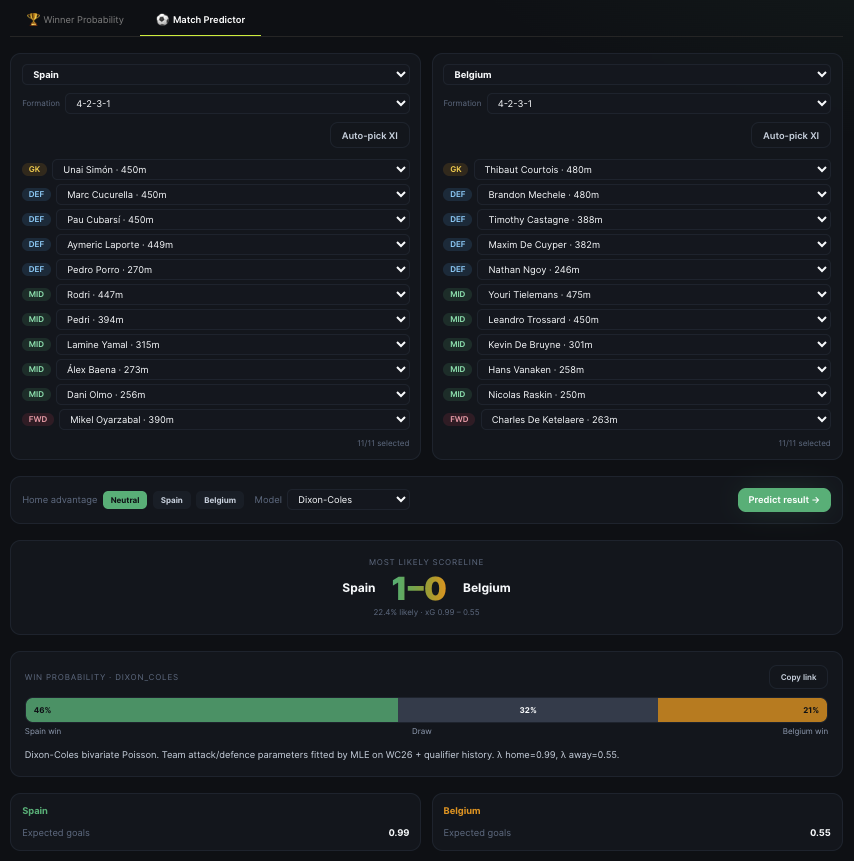
A predictor we backtested before we published it
AnalyseThisWC26 runs a multi-model match predictor — Dixon-Coles, Poisson and Elo — with an out-of-sample track record published in the product itself, next to the predictions. That is the same discipline we bring to a client model: score it honestly on data it has never seen, then show the score.
Read the case studyTools & platforms we build AI Engineering on
- Python
- PyTorch
- scikit-learn
- Claude
- OpenAI
- Open-weight models
- LangChain
- pgvector
- AWS Bedrock
- AWS SageMaker
- Docker
- GitHub Actions
AI Engineering — questions we get asked
Do we need a huge dataset before this is worth doing?
Which model do you use — and are we locked into one vendor?
How do you stop it from making things up?
Does our data get used to train someone else’s model?
How long does an AI Engineering build take?
What happens after launch?
Most engagements touch more than one
A good automation usually needs clean data behind it and a decent interface in front of it. Here’s the rest of what we do.
Have an AI idea that stalled at the demo?
Bring it to a free 30-minute call. We’ll tell you what it would take to make it production-grade — or tell you plainly if it isn’t worth building.
Free 30-min call · no commitment · you own everything we build